


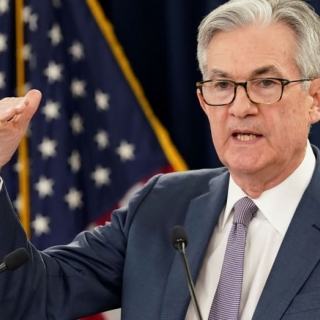
Federal Reserve officials flagged the risk of more sustained inflationary pressures from tariffs when they agreed to keep interest rates steady at their meeting last month.
"A majority of participants noted the potential for inflationary impacts arising from a variety of factors to be more sustained than they had projected," said the minutes of the March 18-19 policy meeting, released Wednesday.
Since that meeting, President Trump has imposed broad and abrupt tariff increases that initially exceeded the high end estimates of most private-sector economists and Fed officials. Trump said Wednesday that he would pause for 90 days many of the largest tariff increases while imposing a higher 125% tariff on China.
Fed officials face an increasingly difficult task because the tariffs are expected to raise the price of imported goods in the short term, but the uncertainty created by the tariffs could also cool business investment and hiring more broadly. Inflation-weary consumers and businesses could simply cut back on purchases, leading to weaker economic activity.
Officials at last month's meeting considered their interest rate setting "well positioned" to address potential risks, the minutes said. The Fed could cut rates if labor market conditions worsen, and it could leave rates unchanged if inflation worsens, the minutes said.
But some policymakers noted that they could "face difficult choices if inflation proves more persistent while the outlook for growth and employment weakens."
In recent public comments, policymakers have suggested that they would pay close attention to consumer and business expectations for future inflation in a scenario that would require interest rate cuts to address rising job losses.
Officials believed those expectations were self-fulfilling, and some said their ability to respond to economic weakness would depend on their confidence that inflation would return to the 2% target after any tariff-related price increases. (Newsmaker23)
Source: Dow Jones Newswires
The upcoming Supreme Court ruling on the legality of President Donald Trump's massive tariffs, which rocked markets in April, is one of the next major tests for US stocks and bonds. Equity markets ha...
The US seized two Venezuela-linked oil tankers in the Atlantic Ocean on Wednesday, one of which was sailing under a Russian flag, as part of President Donald Trump's aggressive efforts to regulate oil...
France is working with partners on a plan on how to respond should the United States act on its threat to take over Greenland, a minister said on Wednesday, as Europe sought to address U.S. President ...
The world community must make clear that U.S. intervention in Venezuela is a violation of international law that makes the world less safe, the Office of the United Nations High Commissioner for Human...
US President Donald Trump threatened on Friday to come to the aid of protesters in Iran if security forces open fire on them, days after unrest that has killed several people and posed the biggest int...
Oil prices stabilized on Thursday (February 12th), as the market reassigned a risk premium to US-Iran tensions despite US inventory data showing swelling domestic supplies. This movement confirms one thing: geopolitical headlines are still more...
Gold prices weakened slightly on Thursday (February 12th), as more solid US employment data reduced market confidence in an imminent Federal Reserve interest rate cut. The strong employment data prompted market participants to shift expectations of...
The Hang Seng Index reversed its downward trend in Hong Kong on Thursday (February 12th), weakening by around 0.9% to around 27,000 after a strong session earlier. This decline halted the momentum of the short term rally, as investors began to...